Small Business Branding: Build Your Message Before Your Website
VOICE YOUR BRAND | MODULE 1 — BUILD YOUR BRAND FOUNDATION
Your business deserves more than a beautiful website. It deserves a message that helps the right people understand what you offer, why it matters, and why they should choose you.

Small business branding begins long before you choose a logo, colors, or website design. It starts with understanding your customers, explaining what you offer, and giving people a clear reason to choose your business.
You know your business better than anyone.
You know how much work goes into your products. You know the care you put into your services. You know what customers appreciate about working with you.
But there's a difference between knowing your business and knowing how to explain it.
And for many independent business owners, that difference becomes obvious the moment they try to write a website, create a flyer, or introduce themselves to a potential customer.
What should your homepage say?
How do you describe your services without sounding like everyone else?
What makes your business different?
And how do you explain everything without overwhelming people with information?
These are not simply website questions.
They're branding questions.
And answering them is where we're going to begin.
Why Small Business Branding Matters Before Website Design
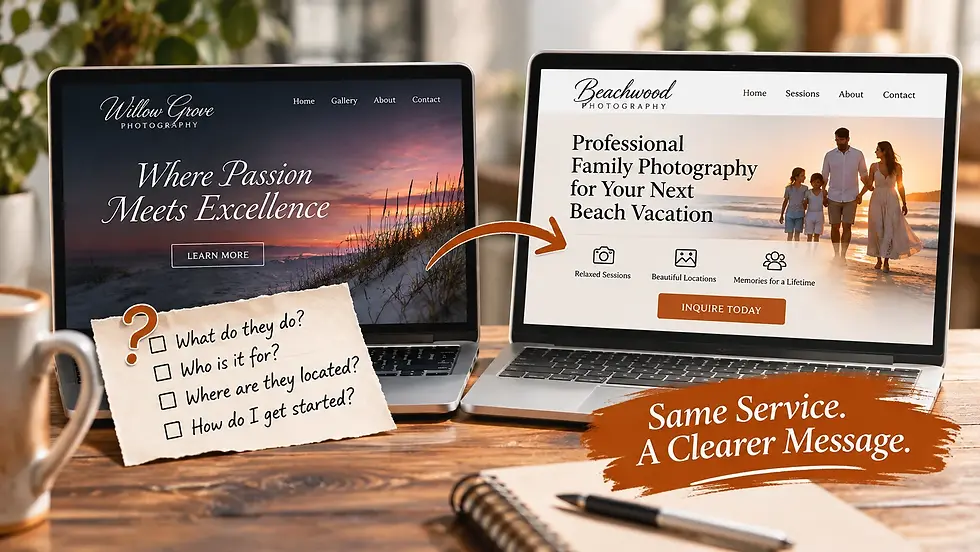
Imagine visiting two websites for businesses that offer similar services.
The first website is visually impressive. It has beautiful photographs, coordinated colors, animated sections, and an attractive logo.
But after scrolling through the homepage, you still don't understand exactly what the business offers.
The headline says something like:
Where Passion Meets Excellence.
It sounds polished, but what does it actually tell you?
Not much.
You still have questions.
What does this company do? Who does it serve? Where does it operate? How do you get started?
--------
Now imagine the second website.
Its design is simpler, but the headline says:
Professional Family Photography for Your Next Beach Vacation.
Immediately, you understand the service, the intended customer, and the occasion.
The website then explains what sessions include, what the experience is like, and how to inquire.
Which website is easier to understand?
The second one.
That doesn't mean design is unimportant. Professional design helps establish credibility, organize information, and create a positive experience.
But beautiful design cannot compensate for a message that leaves visitors confused.
Your website should look professional and communicate clearly.
That's why we're building your brand message before we begin thinking about website layouts.
Small Business Branding Is More Than a Logo
When most people hear the word branding, they think about visual identity.
Logos. Colors. Fonts. Packaging. Business cards.
Those things are part of branding, but they're not the entire picture.
Your brand also includes what customers understand about your business, what they expect from you, and what they remember after interacting with you.
Think about a small business you've recommended to someone.
You probably didn't begin by describing its logo.
You might have said:
"She's wonderful with children who are nervous about having their pictures taken."
"They make beautiful custom gifts, and everything feels so personal."
"He's the person I call when my camera needs repairing."
"They make it easy to order lunch when we're working an event."
Each of those recommendations communicates something important.
It explains what the business does and gives someone a reason to consider it.
That's brand messaging.
Your goal isn't to invent a personality that sounds impressive.
It's to communicate the value your business already provides.
Your brand has two connected parts
Visual identity is how your business looks.
It includes your logo, colors, typography, photography, packaging, and other design elements.
Brand messaging is how your business explains itself.
It includes your ideal customer, products and services, customer benefits, tagline, elevator pitch, website headlines, and calls to action.
The strongest businesses bring these elements together.
Your photography and design attract attention. Your words help people understand what they're looking at.
And when the two work together, your business becomes easier to recognize, understand, and remember.

Why So Many Small Businesses Struggle With Their Message
Small-business owners wear a lot of hats.
You might be the person creating the product, answering customer messages, managing appointments, ordering supplies, handling bookkeeping, and updating social media.
You may not have a marketing department or professional copywriter.
When it's time to describe your business, you naturally begin with what you do.
A candle maker writes:
We sell handmade candles.
A photographer writes:
We offer professional photography services.
A landscaper writes:
We provide lawn care.
A website designer writes:
We build websites.
Those statements aren't wrong.
But they leave important questions unanswered.
What kinds of candles? Who buys them? What makes them appealing?
What type of photography? Who is it for? What should customers expect?
What type of lawn care? Where is it available? What problem does it solve?
What kinds of websites? For which businesses? What does the client receive?
Customers need enough information to decide whether your business is a good fit.
This is one of the most important principles of small business branding:
Don't stop at explaining what you sell. Explain why it matters to the people who need it.

Your Customers Are Thinking About Their Needs
Here's something worth remembering.
Customers don't always think about your business the same way you do.
You might think about the technical details, equipment, ingredients, processes, or experience behind your work.
Your customers are usually thinking about what they need to accomplish.
A photographer may be thinking about lighting, posing, lenses, and editing.
The customer may be thinking:
"My entire family will finally be together on vacation, and I want beautiful photographs of everyone."
A candle maker may be thinking about fragrance combinations, wax, containers, and production methods.
The customer may be thinking:
"I need a thoughtful birthday gift, and I don't want something that feels generic."
A website designer may be thinking about hosting, responsive layouts, search optimization, and page structure.
The customer may be thinking:
"People keep asking if I have a website, and I need somewhere professional to send them."
Neither perspective is wrong.
But your marketing needs to connect your expertise with what customers are trying to accomplish.
Features explain. Benefits connect.
Consider these two descriptions:
We offer professional portrait sessions.
And:
Enjoy a relaxed portrait experience that captures your family together while everyone is on vacation.
The first explains the service.
The second helps a particular customer imagine why the service matters.
You don't need to replace every factual description with emotional language.
You need both.
Customers should understand exactly what you provide and why it could be useful to them.
We'll explore this in greater detail in Lesson 3.

The Importance of Knowing Your Ideal Customer
One of the biggest mistakes in small business branding is trying to speak to everyone at once.
You might believe that the more people you appeal to, the more customers you'll attract.
But when your message becomes too broad, it can become difficult for anyone to recognize that you're speaking to them.
Consider a photographer who offers family portraits, professional headshots, senior portraits, and weddings.
All of those services fall under photography.
But the people shopping for them have different needs.
A business owner looking for headshots may care about professionalism, convenience, and how the images will be used.
A family planning vacation portraits may care about capturing memories, coordinating clothing, and having an enjoyable experience.
A couple planning a wedding may care about experience, reliability, and preserving an important day.
Trying to explain every service in one generic sentence may not serve any of these customers particularly well.
Instead, the photographer can identify the primary audience for the homepage and create clear sections or dedicated pages for the other services.
You don't have to turn customers away
Identifying your ideal customer doesn't mean refusing to serve anyone outside that group.
It means understanding who you most want to reach and what they need to hear.
You can still welcome other customers.
You simply stop expecting one vague marketing message to speak equally well to everyone.
In Lesson 1, we'll explore how to identify customers based on their situations, needs, and reasons for buying—not just their age, income, or location.
What Makes Your Business Different?
This question can make business owners uncomfortable.
You may feel that you don't have anything especially unique to offer.
Perhaps other businesses sell similar products, provide similar services, or operate in the same community.
But being different doesn't always mean inventing something nobody else offers.
Your difference may come from the way you work.
Perhaps you specialize in a particular customer need.
Maybe you offer convenient appointments, personal guidance, locally made products, specialized experience, or a service that's difficult to find in your area.
Your advantage may be a combination of qualities rather than one extraordinary feature.
For example, a camera repair business might emphasize experienced technicians, clear communication, and a convenient process for sending equipment in for service.
A handmade gift business might emphasize customization, local pickup, and thoughtful packaging.
A photographer might emphasize helping clients feel comfortable and creating a relaxed experience.
These are meaningful differences when they're true and relevant to customers.
Your job isn't to claim you're the best. It's to help customers understand why your business may be the right choice for them.
And whatever you promise, you should be able to deliver.

How Small Business Branding Supports SEO and Google Search
Now let's connect your brand foundation to something many business owners care deeply about:
Getting found online.
Search engine optimization, commonly called SEO, helps search engines understand your content and helps people discover relevant pages.
But before you can optimize a website, you need to understand what the website should communicate.
Think about how customers search.
Someone might search for:
Family photography during a beach vacation
Handmade gifts near their town
Camera sensor cleaning services
Mobile dog grooming in their area
Website design for small businesses
These searches describe specific needs.
Your website should clearly explain whether your business meets those needs.
That means using accurate service descriptions, relevant location information, helpful headings, and content that answers customer questions.
It also means choosing page topics based on what you actually offer.
Keywords should support your message, not replace it
A keyword is a word or phrase someone might use when searching.
For this article, our primary focus keyword is small business branding.
That phrase appears naturally in the title, introduction, and relevant headings because it's genuinely what this article discusses.
But repeating a keyword over and over doesn't make an article more useful.
And putting a keyword in an SEO title, page heading, and meta description does not guarantee rankings.
Search performance depends on many factors, including the relevance and usefulness of your content, competition, links, and whether search engines can access your pages.
The goal is to make your website useful to real people while giving search engines clear information about the page.
A practical lesson about SEO titles
When we create an SEO title, we'll usually aim for approximately 55–65 characters when practical.
For example:
Small Business Branding: Build Your Brand | Web Vybz
The title includes our focus keyword, describes the topic, and identifies the business.
But character count isn't a Google ranking factor, and search results don't display a fixed number of characters. Google may shorten or rewrite a title depending on the available space and search context.
What about meta descriptions?
A meta description is a short summary that search engines may use beneath a page's title in search results.
We'll generally aim for approximately 155–165 characters as a writing guideline.
A good description should accurately summarize the page and give someone a reason to visit.
Google may display different text from the page when it better matches a particular search.
The lesson is simple: Write for clarity first, then refine for search visibility.
We'll explore SEO titles, meta descriptions, page headings, keywords, and search intent in greater detail in the website and SEO training modules.
For now, we're building the foundation those decisions will depend on.
Seven Lessons to Build Your Brand Foundation
Voice Your Brand is designed to take you from a collection of ideas about your business to a clear, usable message.
You won't need to learn complicated marketing terminology before getting started.
You'll work through seven practical lessons, each building on the previous one.
Lesson 1: Identify Your Ideal Customer
Discover who you're best positioned to serve, what brings those customers to your business, and what they're hoping to accomplish.
You'll learn why customer needs and buying situations often tell you more than demographics alone.
Lesson 2: Understand the Before and After
Explore what your customer is experiencing before purchasing and what changes after using your product or service.
This helps you communicate outcomes without making exaggerated promises.
Lesson 3: Turn Features Into Benefits
Learn how to explain the practical value of your products and services.
You'll also identify evidence that supports your claims, such as experience, examples, customer feedback, or specific service details.
Lesson 4: Write Your Brand Tagline
Develop a short, memorable statement that fits your business.
You'll learn how to test potential taglines for clarity, specificity, and truthfulness rather than choosing something simply because it sounds clever.
Lesson 5: Create Your Elevator Pitch
Build a natural introduction that explains who you help, what you offer, and why it's useful.
You'll be able to adapt this message for conversations, networking situations, business descriptions, and online profiles.
Lesson 6: Write Your Homepage Message
Bring your work together into a homepage headline, supporting explanation, and clear next action.
You'll begin turning your brand foundation into actual website content.
Lesson 7: Complete Your Brand Foundation
Organize and review everything you've created.
You'll leave with a practical document you can use when writing your website, updating business profiles, creating marketing materials, or planning future promotions.
One Workbook, Two Ways to Use It
This course is designed for independent business owners who want to understand and communicate their own businesses more clearly.
You don't have to hire Web Vybz to benefit from it.
As you complete each online lesson, you'll work through the corresponding exercises in your printable companion workbook.
The articles provide the teaching.
The workbook gives you a place to apply what you've learned.
By the end, you'll have a completed Brand Foundation & Website Content Brief.
That document will bring together your customer information, business message, products and services, homepage direction, contact details, and other information needed to begin planning website content.
If you're building your own website
You can use your completed workbook as a guide when creating pages, writing descriptions, and deciding what information visitors need.
You'll have a much clearer starting point than a blank website template.
If Web Vybz is building your website
Your completed workbook becomes the starting point for your website project.
You won't need to fill out another full branding questionnaire or repeat the same discovery process.
We'll use your answers to develop website content, organize pages, and identify any remaining information needed for the build.
Some details, such as domain access, final images, and approval of website copy, may still need to be confirmed.
But your core message will already be documented.
That's one of the reasons we've designed the course this way.
The work you do here should continue to be useful long after you finish the lessons.

What You'll Have When You Finish Module 1
By the end of this module, you should be able to explain your business more clearly and consistently.
You'll have identified your primary customer and what motivates that person to buy.
You'll understand the practical benefits your business provides.
You'll have a tagline and elevator pitch you can adapt across different situations.
You'll have the beginnings of your homepage content.
And you'll have a completed Brand Foundation & Website Content Brief that helps you move toward your next marketing or website project.
That doesn't mean your message can never change.
Businesses grow. Services evolve. Customers' needs change.
Your brand foundation should be something you revisit and refine as you learn more.
But you'll no longer be starting from nothing.
You'll have a thoughtful, documented starting point.
You Don't Need to Have Everything Figured Out Today
Some business owners begin this process with a clear understanding of their customers and services.
Others have been operating for years but have never written those ideas down.
Both are welcome here.
You may discover that you serve several different audiences.
You may realize that your current website doesn't explain your most valuable service.
You may find that the way customers describe your business is different from the way you've been describing it.
Those discoveries are useful.
The purpose of this course isn't to make every business sound the same.
It's to help you communicate what makes your business valuable in a way that feels authentic, specific, and understandable.
Take your time with the exercises.
Use examples from real customer conversations.
Write in language that feels natural.
And remember that a clear, simple message is often more useful than one filled with impressive-sounding marketing phrases.

Ready to Build Your Brand Foundation?
Before you choose your website layout, rewrite your About page, or create your next marketing campaign, start with one question:
Who are you really trying to reach?
That's where Lesson 1 begins.
You'll learn how to identify your ideal customer by looking at their needs, situations, priorities, and reasons for choosing a business like yours.
Then you'll complete the first exercise in your Voice Your Brand workbook.
Each lesson will help you develop another piece of your message.
And by the end, those pieces will come together into something you can actually use.
Continue to Lesson 1: Who Is Your Ideal Customer?
VOICE YOUR BRAND — A WEB VYBZ EDUCATIONAL WORKSHOP
Get clear. Get confident. Get found online.
Comments